WebdriverIO
Add visual checks to your existing WebdriverIO tests with the @wopee-io/wopee.wdio service. Each browser.track...() command sends a screenshot to Wopee.io, which compares it with the approved baseline. You review the differences in Commander and approve or reject them.
This page walks through a complete example on Sauce Demo: two screenshots, a first run that creates the baselines, and a second run that catches a visual bug. Verified with @wopee-io/wopee.wdio 6.0.0 and WebdriverIO 9 (Mocha, Chrome). Prefer a ready project? Start from the template project.
Prerequisites
- Node.js 20 or newer
- WebdriverIO 9 (or 8) with a test framework such as Mocha.
npm init wdiosets one up. - Google Chrome. WebdriverIO 9 downloads the matching ChromeDriver on the first run.
- A Wopee.io account at cmd.wopee.io
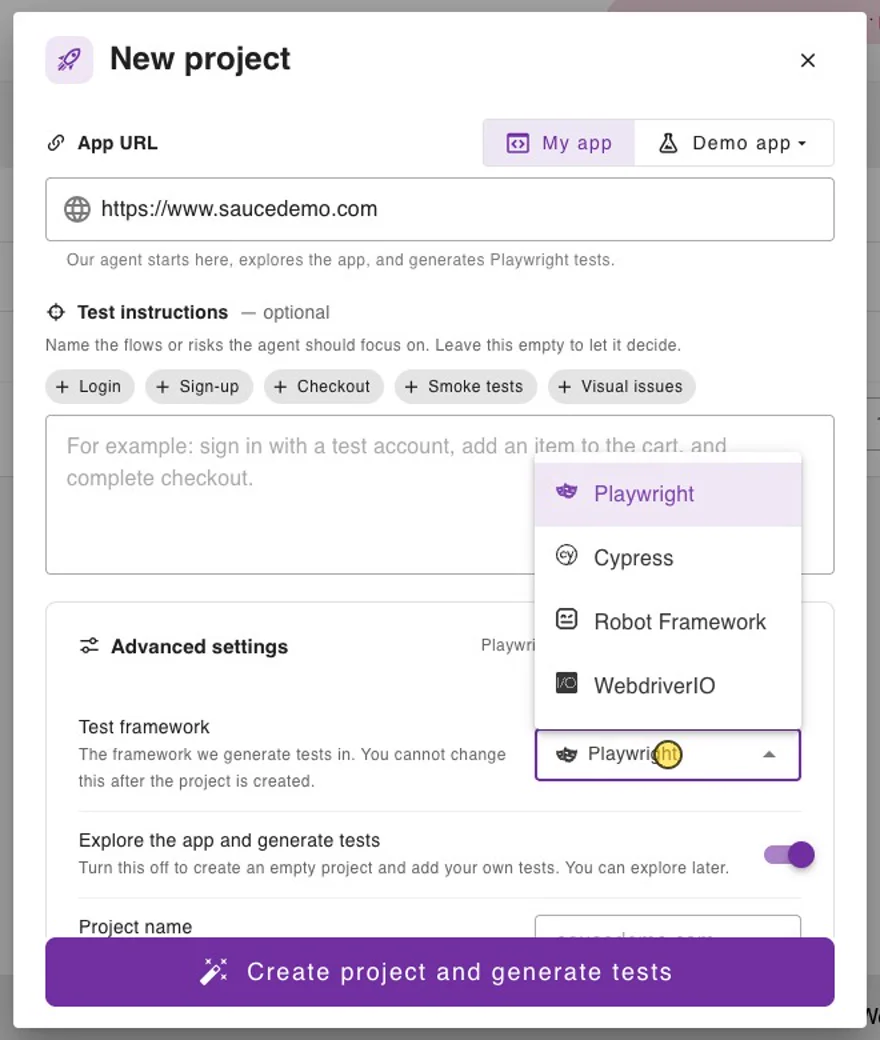
1. Create a project
- In Commander, click NEW PROJECT and paste the App URL (for example
https://www.saucedemo.com). - Open Advanced settings and set Test framework to WebdriverIO. Explore the app and generate tests switches off, because test generation is available for Playwright only.
- Click Create project.
2. Get the API key
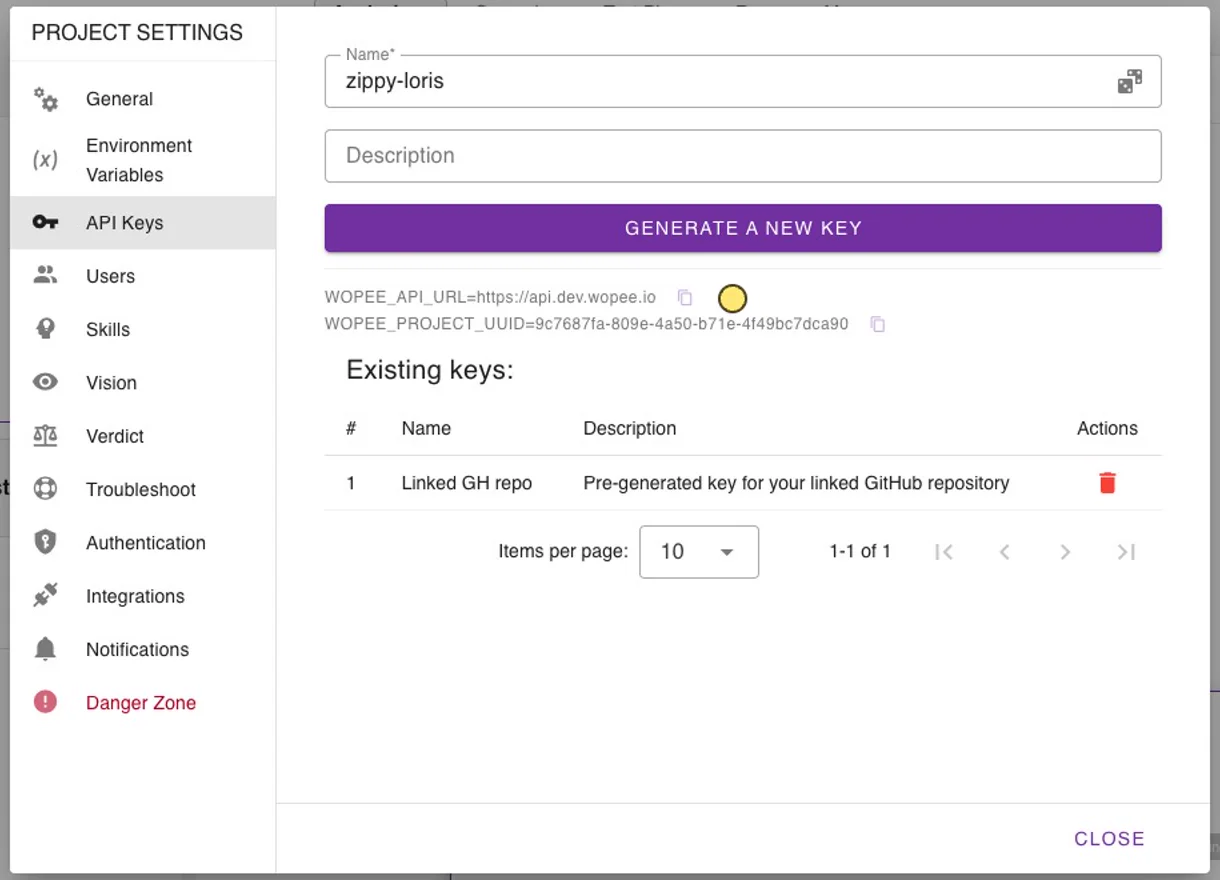
- In the project, open More › Settings › API Keys and copy
WOPEE_PROJECT_UUID. - Enter a name, click Generate a new key and copy
WOPEE_API_KEY. The key is shown only once.
3. Install
npm install --save-dev @wopee-io/wopee.wdio dotenv
webdriverio is a peer dependency; projects created with npm init wdio already have it.
Create a .env file in the project root:
WOPEE_PROJECT_UUID=your-project-uuid
WOPEE_API_KEY=your-api-key
WOPEE_API_URL is needed only for a self-hosted instance (its URL is shown in API Keys); the service defaults to https://api.wopee.io. Add .env to .gitignore. In CI, set the same variables as secrets.
4. Configure the service
Load .env and add the service to wdio.conf.ts:
import 'dotenv/config';

export const config: WebdriverIO.Config = {
  // ...your runner, specs, capabilities, framework and reporters
  services: [
    [
      '@wopee-io/wopee.wdio',
      {
        screenshotValidation: {
          apiUrl: process.env.WOPEE_API_URL,
          apiKey: process.env.WOPEE_API_KEY,
          projectUuid: process.env.WOPEE_PROJECT_UUID,
        },
        isLandscape: false,
      },
    ],
  ],
};
- The connection settings go inside
screenshotValidation. The service does not pick upWOPEE_*variables on its own; pass every value through the config. isLandscapesits next toscreenshotValidation. Set it tofalsefor desktop browsers: the defaulttrueis meant for mobile devices in landscape orientation and crops desktop screenshots to the wrong size.
For TypeScript, add the service types to tsconfig.json so browser.trackScreen() and the other commands are typed:
{
  "compilerOptions": {
    "types": ["node", "@wdio/globals/types", "@wopee-io/wopee.wdio"]
  }
}
5. Track screenshots in your test
import { browser, $ } from '@wdio/globals';

const user = process.env.SAUCE_USER ?? 'standard_user';

describe('Sauce Demo', () => {
  before(async () => {
    await browser.startSuite(`WebdriverIO demo ${new Date().toISOString().slice(0, 16)}`);
  });

  it('logs in and shows the products', async () => {
    await browser.startScenario('WebdriverIO: login and products');

    await browser.url('https://www.saucedemo.com');
    await $('#login-button').waitForDisplayed();
    await browser.execute(async () => {
      await document.fonts.ready;
    });
    const login = await browser.trackScreen({ stepName: 'Login page' });
    console.log('Login page:', login.screenshotValidationResult);

    await $('#user-name').setValue(user);
    await $('#password').setValue('secret_sauce');
    await $('#login-button').click();
    await $('.inventory_list').waitForDisplayed();
    await browser.execute(async () => {
      await Promise.all([...document.images].map((img) => img.decode().catch(() => {})));
    });

    const products = await browser.trackScreen({ stepName: 'Products' });
    console.log('Products:', products.screenshotValidationResult);

    await browser.stopScenario();
  });
});
| Command | Purpose |
|---|---|
browser.startSuite(name) |
Starts a suite (one entry in Runs). Call it once, in before. A suite with the same name and branch is reused, so the timestamp gives every run its own entry. |
browser.startScenario(name) |
Starts a scenario. Use a stable name; it is part of the baseline key. |
browser.trackScreen({ stepName }) |
Takes a screenshot of the visible part of the page and compares it with the baseline. |
browser.stopScenario() |
Closes the scenario. |
The two browser.execute() calls wait for web fonts and for every image to decode before tracking. See Wait for fonts and images before tracking.
Other track commands:
| Command | Captures |
|---|---|
browser.trackFullPageScreen({ stepName }) |
The whole page, scrolled and stitched |
browser.trackElement({ stepName, element }) |
One element. In WebdriverIO 9 pass await $('selector').getElement(). |
browser.trackImage({ stepName, imageBase64 }) |
Any PNG you provide as base64, for example from browser.takeScreenshot() |
There is no wopeeTrack command in WebdriverIO. All track commands accept the optional comment, customTags, pixelToPixelDiffTolerance, viewport and baselineBranchName, and return { screenshotValidationResult: { stepName, imageUrl, status } }.
6. First run: create the baselines
npx wdio run wdio.conf.ts
[0-0] Login page: {
[0-0]   stepName: 'Login page',
[0-0]   imageUrl: 'https://cmd.wopee.io/tests?projectId=...&suiteId=...&stepId=...&tab=RUNS',
[0-0]   status: 'new'
[0-0] }
[0-0] Products: {
[0-0]   stepName: 'Products',
[0-0]   imageUrl: 'https://cmd.wopee.io/tests?projectId=...&suiteId=...&stepId=...&tab=RUNS',
[0-0]   status: 'new'
[0-0] }
[0-0] PASSED in chrome - file:///test/specs/saucedemo.visual.ts
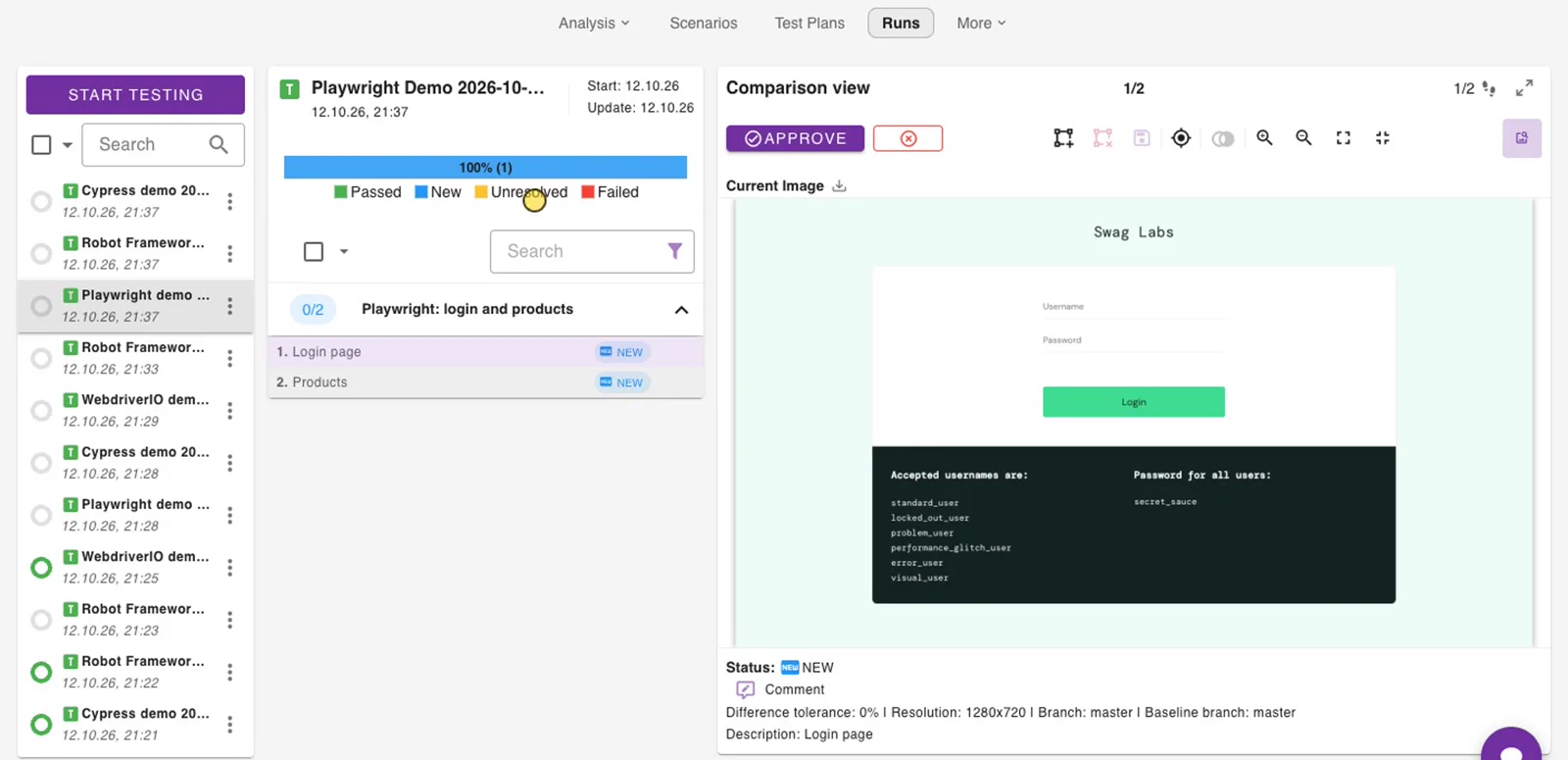
Both steps are new: there is no baseline yet. Add --logLevel info to see when the suite and scenario start and stop.
7. Approve in Runs
Open the project and go to Runs. Select the run WebdriverIO demo ..., then each step, and click Approve. The screenshot becomes the baseline.
8. Second run: catch a visual bug
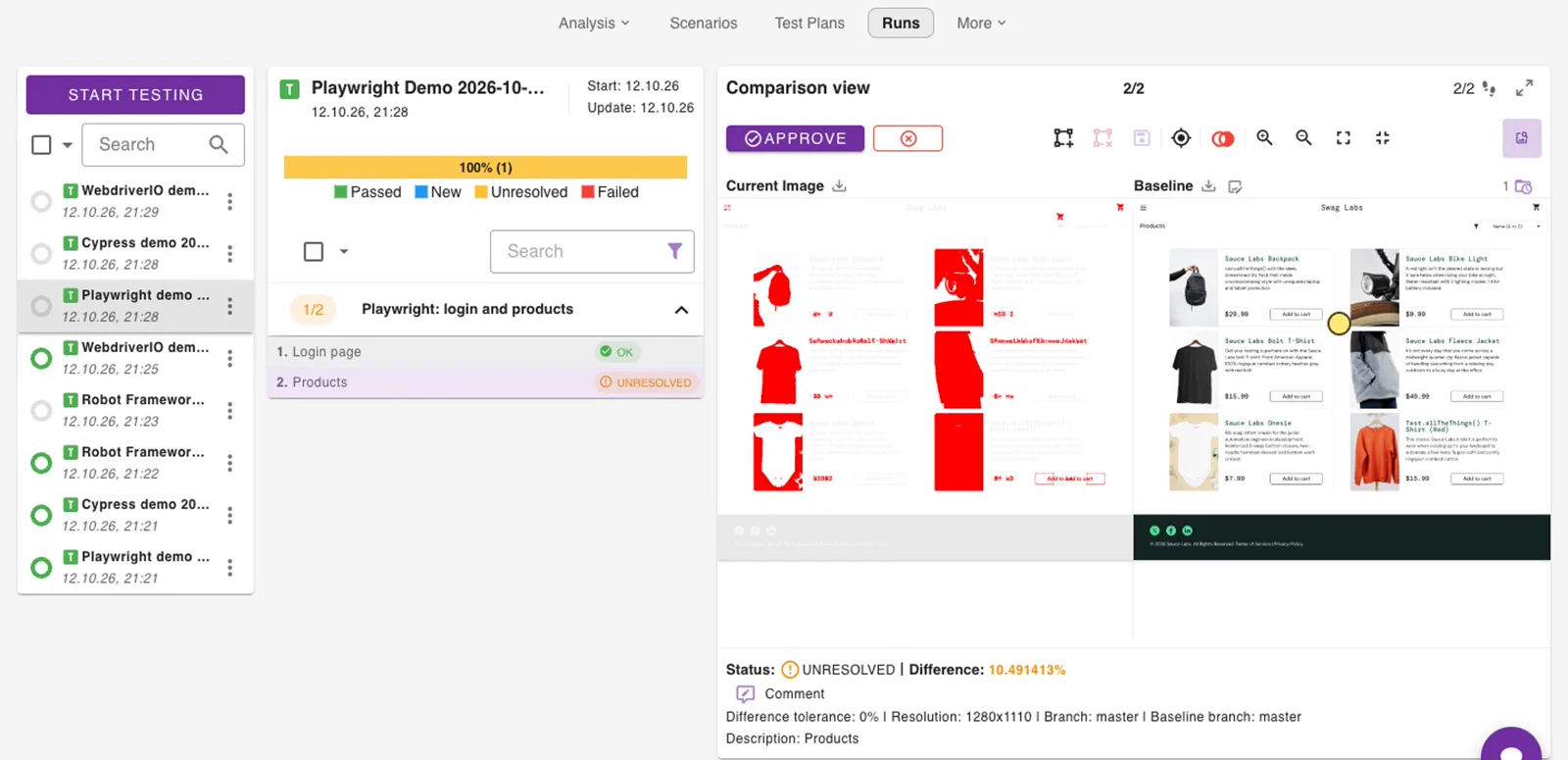
Sauce Demo has a visual_user whose products page is visually broken. Run the same test as that user:
SAUCE_USER=visual_user npx wdio run wdio.conf.ts
[0-0] Login page: {
[0-0]   stepName: 'Login page',
[0-0]   imageUrl: 'https://cmd.wopee.io/tests?projectId=...&suiteId=...&stepId=...&tab=RUNS',
[0-0]   status: 'ok'
[0-0] }
[0-0] Products: {
[0-0]   stepName: 'Products',
[0-0]   imageUrl: 'https://cmd.wopee.io/tests?projectId=...&suiteId=...&stepId=...&tab=RUNS',
[0-0]   status: 'unresolved'
[0-0] }
[0-0] PASSED in chrome - file:///test/specs/saucedemo.visual.ts
Login page matches the baseline. Products is unresolved: open it in Runs, inspect the highlighted differences and Reject it as a bug, or Approve it if the change is intended.
Good to know
-
A difference does not fail the test. The test passes and the step waits for review. To fail the test as well, check the returned status:
const products = await browser.trackScreen({ stepName: 'Products' }); expect(products.screenshotValidationResult?.status).not.toBe('unresolved'); -
Baselines are identified by
<scenario name>-<step name>plus the branch and the environment labels. Keep both names stable between runs. - Branches: set
branchNameinscreenshotValidation(defaultmaster). See Branches in CI and Baselines and branches. - Statuses:
new,ok,unresolved,autoApproved. See How it works.
Configuration
Options inside screenshotValidation:
| Option | Default | Description |
|---|---|---|
apiKey |
required | API key from More › Settings › API Keys |
projectUuid |
required | Project UUID from the same page |
apiUrl |
https://api.wopee.io |
API endpoint. Set it only for a self-hosted instance (its URL is shown in API Keys). |
branchName |
master |
Branch the screenshots belong to |
baselineBranchName |
Branch to compare with when the current branch has no baseline yet | |
pixelToPixelDiffTolerance |
0 |
Difference in percent that still counts as a match |
customTags, comment |
Stored with each step | |
browser, device, os, viewport |
Labels that are part of the baseline identity | |
screenshotValidationEnabled |
true |
false runs the tests without sending screenshots |
Options next to screenshotValidation:
| Option | Default | Description |
|---|---|---|
isLandscape |
true |
Set to false for desktop browsers |
imageProcessing |
mode: 'none' |
mode: 'masking' or 'cropping' with xLeft, xRight, yTop, yBottom and maskColor to hide or cut screen edges on every screenshot |
Branches in CI
screenshotValidation: {
  apiUrl: process.env.WOPEE_API_URL,
  apiKey: process.env.WOPEE_API_KEY,
  projectUuid: process.env.WOPEE_PROJECT_UUID,
  branchName: process.env.WOPEE_BRANCH_NAME ?? 'master',
  baselineBranchName: process.env.WOPEE_BASELINE_BRANCH_NAME,
},
The repository Wopee.io creates for a WebdriverIO project runs from Commander (Runs › Start testing), not on push; see Run from Commander.
Template project
When you create a project with the test framework WebdriverIO, Wopee.io creates a repository for it from the WebdriverIO template and fills in your project settings. It is a ready WebdriverIO 9 setup (Mocha, headless Chrome) with the service configured as above and one sample test.
| File | What it does |
|---|---|
wdio.conf.ts |
Registers the service with the screenshotValidation block and isLandscape: false. baseUrl is WOPEE_PROJECT_URL, the App URL of your project. |
tests/example.spec.ts |
The sample test: opens your app at 1920x1080 and tracks three steps, fullPage (trackFullPageScreen), screen (trackScreen) and image (trackImage). |
.env.example |
Your project's values for local runs. Only WOPEE_API_KEY is empty. |
.github/workflows/tests.yml |
The workflow Commander starts. |
Run from Commander
Nothing to set up. In Commander open Runs › Start testing. Commander runs the repository's tests in GitHub Actions with your project settings and shows the results under Runs.
The workflow has no manual Run workflow button in GitHub and does not run on push. To run the tests on every push or pull request, add your own trigger to .github/workflows/tests.yml.
Run locally
Needs Node.js 20 or newer, git and Google Chrome.
git clone <your project's repository>
cd <repository folder>
cp .env.example .env
Open .env and paste an API key after WOPEE_API_KEY=. Create the key in Commander › More › Settings › API Keys; it is shown only once (see Get the API key). The other values are already your project's. .env is in .gitignore; do not commit it.
npm ci
npm test
The console prints a Tracking response line for each tracked step, with its status and a link to the step in Commander. WOPEE_API_URL stays commented out for cmd.wopee.io; set it only for a self-hosted instance.
Review the results
Open Runs in Commander and select the suite service browsers- followed by the date and time of the run. The sample puts the date and time into the suite name, so every run is its own entry.
- First run: the steps
fullPage,screenandimagearenew. Check the screenshots and click Approve; they become the baselines. - Next runs: a step is
okwhen the page looks the same, orunresolvedwhen it differs. Open it, then Approve it as the new baseline or Reject it as a bug.
A visual difference is reported in Commander; it does not fail the WebdriverIO test. See Review in Runs.
Local runs and Commander baselines
Compare like with like. A screenshot from your machine differs from one taken by Commander's runner: screen scaling and font rendering are not the same, for example on a Mac. A local run against a baseline approved from Commander is therefore unresolved. Keep the baselines from one place, usually Commander, and do not approve local screenshots over them.
For small rendering differences between runs on the same machine, set WOPEE_PIXEL_TO_PIXEL_DIFF_TOLERANCE in .env: the difference in percent that still counts as a match. The template already maps it to pixelToPixelDiffTolerance.
Make it yours
- Your app:
browser.url('/')opensbaseUrl, which isWOPEE_PROJECT_URL. For local runs change it in.env; for runs from Commander change the App URL of the project in Commander. - More checks: add
await browser.trackScreen({ stepName: 'Inventory page' })after an interaction. EverystepNamegets its own baseline. See Other track commands for full page, element and image. - More tests: add
*.spec.tsfiles undertests/and list them inspecsinwdio.conf.ts. Every test needs what the sample has: start a suite and a scenario, track, stop the scenario. - Desktop screenshots: keep
isLandscape: false;trueis for mobile devices in landscape and rotates desktop screenshots.
Cloned the public template?
If .env contains put-your-project-uuid-here, you cloned the public template, not your project's repository. Put in your project UUID from More › Settings › API Keys (WOPEE_PROJECT_UUID) and your app's URL (WOPEE_PROJECT_URL), then run as in Run locally.
Troubleshooting
| Message | Fix |
|---|---|
Failed to initialise service @wopee-io/wopee.wdio naming apiKey or projectUuid |
The value is missing. Check .env, that wdio.conf.ts starts with import 'dotenv/config', and that the values are inside screenshotValidation. |
must be an absolute URL including the scheme |
Write apiUrl with https://. |
ZodError ... Expected object, received null or an authorization error |
The API key usually belongs to another Wopee.io instance or another project. Create the key in the Commander you run against. Set WOPEE_API_URL only for a self-hosted instance. |
Error: Unsupported type: function from trackElement |
The selector matched nothing on the page. Use a selector from your app. |
browser.trackScreen is not a function |
The service is not listed in services, or the package is not installed. |
| The screenshot is narrow and tall, with a white area | Set isLandscape: false next to screenshotValidation. |
A step is unresolved on every run without a visible change |
The page was still loading. Wait for fonts and images before tracking, or draw an ignore area over the dynamic region in the comparison view. |
| All runs end up in one entry in Runs | The suite name is constant. Add a timestamp or build ID to it. |
Another framework or language? Send screenshots through the GraphQL API.